When I arrived at Mireuksa Temple Site in Iksan, the first thing that caught my attention was not simply the size of the ruins.
It was the two stone pagodas.
Standing across the open temple grounds, they look as if they belong to completely different periods.
One is rough and irregular, with parts of its ancient stone structure still visible.
The other rises much higher, with clean lines and a far more complete appearance.
At first glance, I wondered:
Why do the two pagodas at Mireuksa look so different?
That question ended up making the visit much more interesting than I expected.
My wife and I had come to Iksan to see one of Korea’s most important Baekje archaeological sites. After walking around the old temple grounds under a very hot summer sky, we finished the trip in a much more ordinary Korean way — with two bubbling bowls of sundubu-jjigae, or soft tofu stew.
It was a simple day trip.
But it connected two things I enjoy about traveling in Korea: discovering the story behind a place, and finding something good to eat afterward.
First, What Was Mireuksa?
Today, Mireuksa is a temple site.
That distinction matters.
If you arrive expecting an active Buddhist temple filled with monks, prayer halls and worshippers, this place feels very different.
Much of the original temple disappeared long ago.
What remains is a large archaeological landscape at the foot of Mireuksan Mountain, where the layout of one of ancient Baekje’s most important Buddhist complexes can still be traced.
Baekje was one of Korea’s Three Kingdoms, and UNESCO describes Mireuksa as part of the later Baekje world that flourished through extensive cultural and technological exchanges with ancient China and Japan. Mireuksa Temple Site, together with Wanggung-ri in Iksan and six sites in Gongju and Buyeo, forms the Baekje Historic Areas, inscribed on the UNESCO World Heritage List in 2015.
What surprised me was the scale.
There isn’t a dense collection of surviving wooden buildings here.
Instead, there is space.
A lot of it.
Walking across the grounds makes you realize that you’re not looking at one surviving monument. You’re standing where an enormous religious complex once operated more than a thousand years ago.
UNESCO’s evaluation of the site describes a particularly unusual arrangement: three pagodas and three prayer halls arranged in parallel, with the central section being the largest. The entire complex also included corridors, monks’ quarters and a lecture hall.
Knowing that changed the way I looked at the empty ground around me.
The empty space wasn’t really empty.
It was where the rest of Mireuksa once stood.
The Ancient Stone Pagoda That Survived
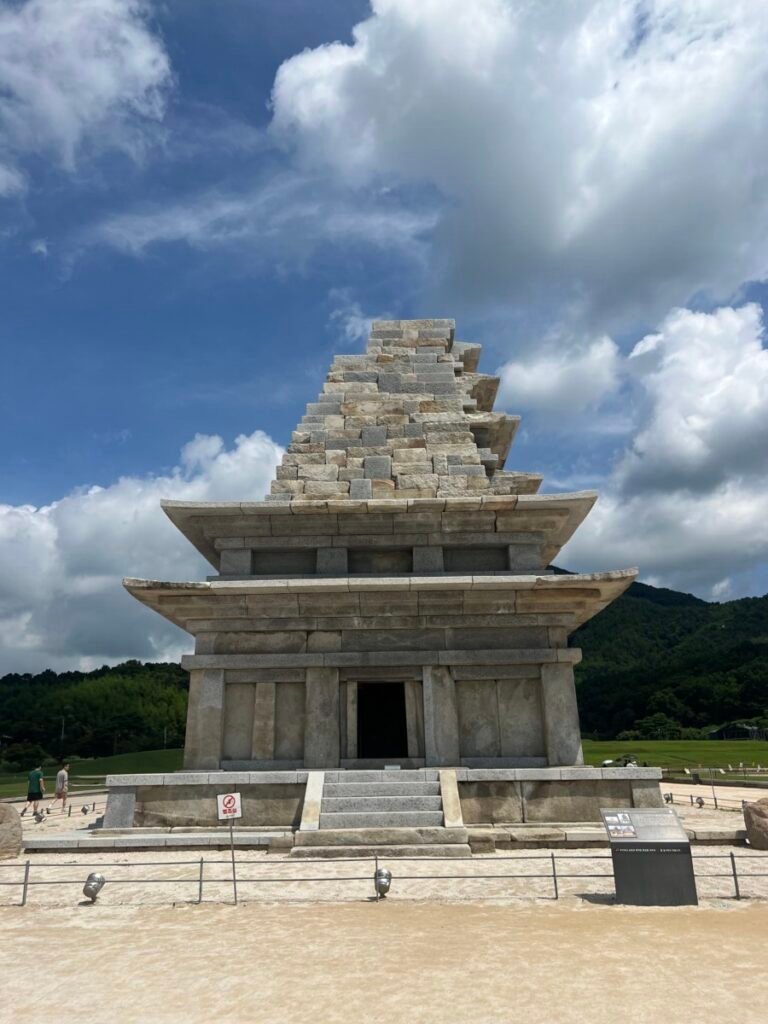
The monument I found most interesting was the Mireuksa Stone Pagoda, commonly referred to as the west pagoda.
It doesn’t have the perfectly symmetrical appearance people might expect from a restored historic monument.
And that’s exactly what makes it fascinating.
Some sections look almost fragmented. Massive stone blocks stack upward in a structure that, to me, looks somewhere between a traditional Korean stone pagoda and a building made from stone.
There’s a reason for that impression.
The pagoda is an important example of how architectural forms associated with earlier wooden structures were translated into stone.
More importantly, archaeology gave researchers something unusually concrete about its age.
During work on the pagoda, a reliquary deposit was discovered inside. Evidence from that discovery confirmed that the west pagoda was built in 639 CE, during the reign of King Mu of Baekje.
That date completely changes the feeling of standing in front of it.
Suddenly this isn’t just an old Korean building.
You’re looking at architecture connected to a kingdom that disappeared in 660, only a few decades later.
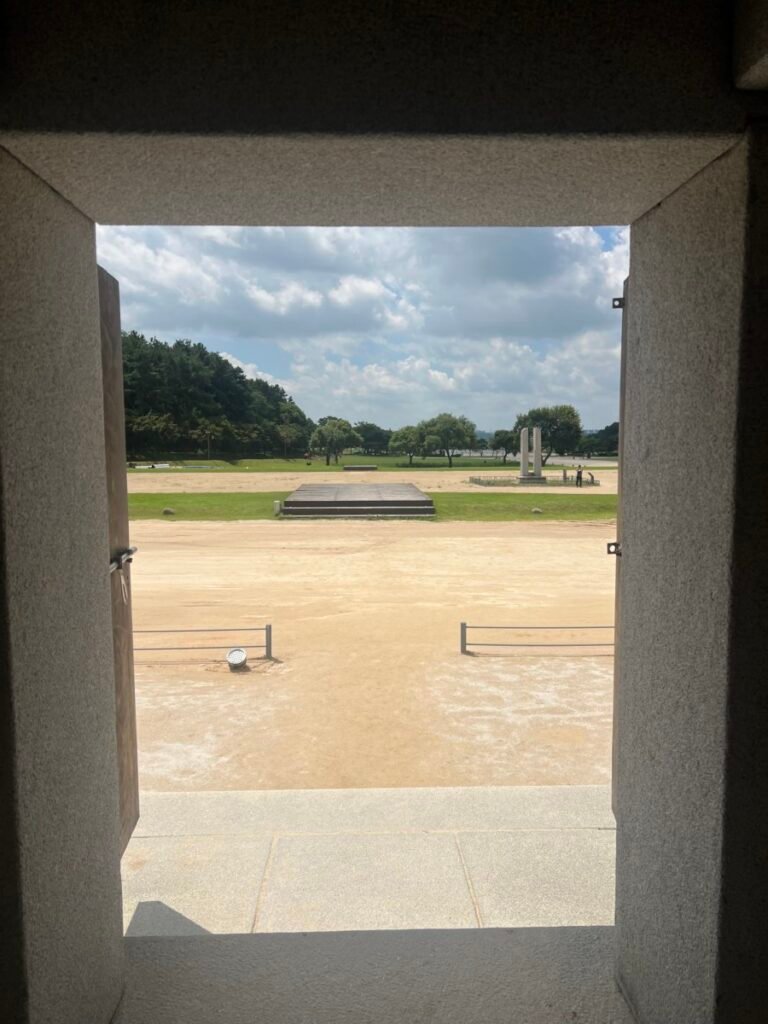
One of my favorite photographs from the visit was actually taken looking outward.
The thick stone structure frames the grass, trees and sky outside almost like a window.
For a moment, instead of looking at the monument, I was looking through it.
That was probably the moment when the age of the place felt most tangible to me.
Museums can explain history with dates.
At archaeological sites, sometimes a doorway does a better job.
Then Why Does the Other Pagoda Look So Different?
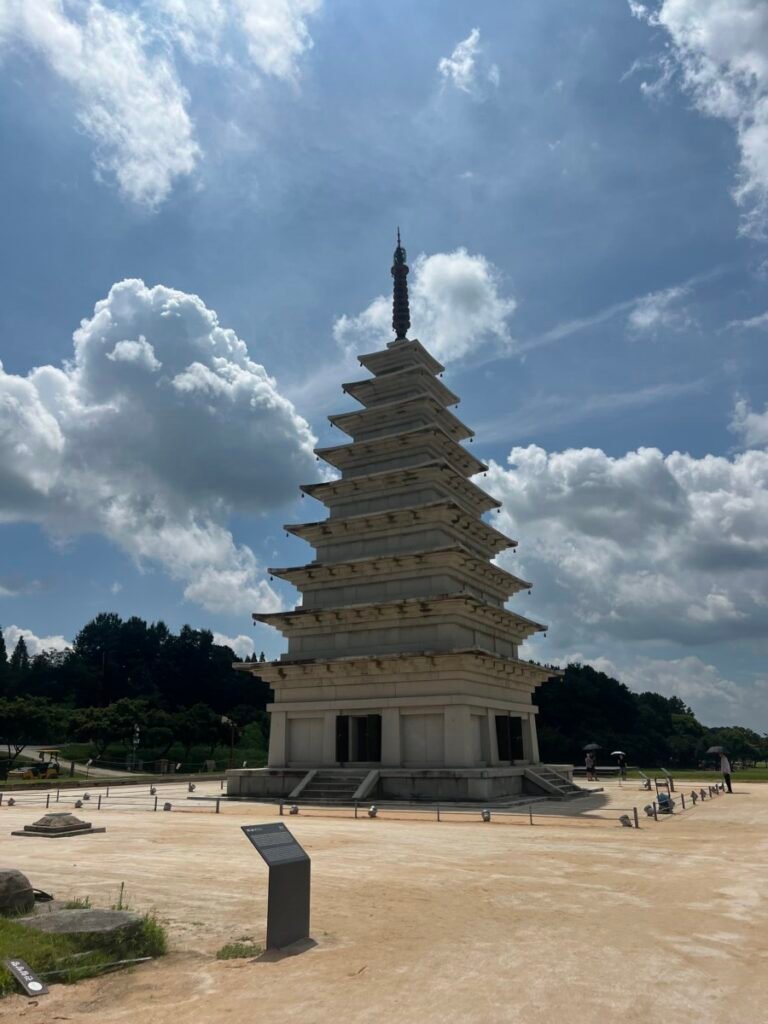
Then there is the pagoda on the other side.
It looks dramatically different.
It’s taller, cleaner and much more complete.
The reason is important for understanding what you’re actually seeing at Mireuksa.
The original east stone pagoda collapsed long ago. The structure standing there today is a reconstruction, while the surviving west pagoda preserves ancient material that has undergone extensive conservation and restoration.
UNESCO’s evaluation records that the eastern stone pagoda had collapsed, while the western pagoda remained standing but unstable when archaeological investigation began in the twentieth century.
So the two pagodas offer two very different encounters with the past.
One allows us to see surviving ancient architecture.
The other helps us visualize what a more complete pagoda at this enormous Baekje temple complex may have looked like.
I actually liked seeing both.
If everything at Mireuksa had been reconstructed to look new, I think some of the site’s archaeological character would have been lost.
But if nothing had been reconstructed, it would be much harder for an ordinary visitor like me to imagine the original scale of the temple.
Standing between the two made that contrast visible.
Mireuksa Was More Than a Local Temple
This is where Mireuksa becomes more interesting than just another old pagoda.
Baekje existed in a period when the kingdoms of East Asia were actively exchanging religion, technology, art and architectural knowledge.
UNESCO specifically recognizes the Baekje Historic Areas for demonstrating exchanges among the ancient kingdoms of Korea, China and Japan, including developments in construction techniques and the spread of Buddhism.
That matters because it’s easy to look at an ancient Korean monument only within the borders of modern Korea.
The world that produced Mireuksa was more connected than that.
Ideas moved.
Religions moved.
Craftsmen and technologies moved.
And Baekje was part of those exchanges.
That wider story is one of the reasons Mireuksa and the other Baekje sites in Iksan, Gongju and Buyeo were collectively recognized as a World Heritage property.
It also fits what I increasingly enjoy about traveling around Korea.
A place can look quiet today while having once belonged to a much larger world.
Walking Through the Site in Summer
There is one practical thing I definitely remember from our visit.
It was hot.
The sky looked beautiful in the photos — huge white clouds against deep blue — but much of Mireuksa is an open archaeological site.
That means there isn’t always much shade between you and the summer sun.
We walked around the pagodas and across the grounds, stopping to look at the structures and information panels.
The open landscape is actually one of the strengths of the site because you can see how large the temple complex was.
But in the middle of summer, you feel that openness physically too.
If I visited again during Korea’s hottest months, I would bring water, sun protection and probably try to arrive earlier in the morning.
Spring or autumn would probably make it much easier to spend longer slowly exploring the grounds.
Still, the weather gave us one thing in return.
Those clouds.
Against the stone pagodas, they made the entire site look much more dramatic than I had expected.
After Baekje History, We Went Looking for Lunch
By the time we finished walking around, history was no longer the only thing on my mind.
I was hungry.
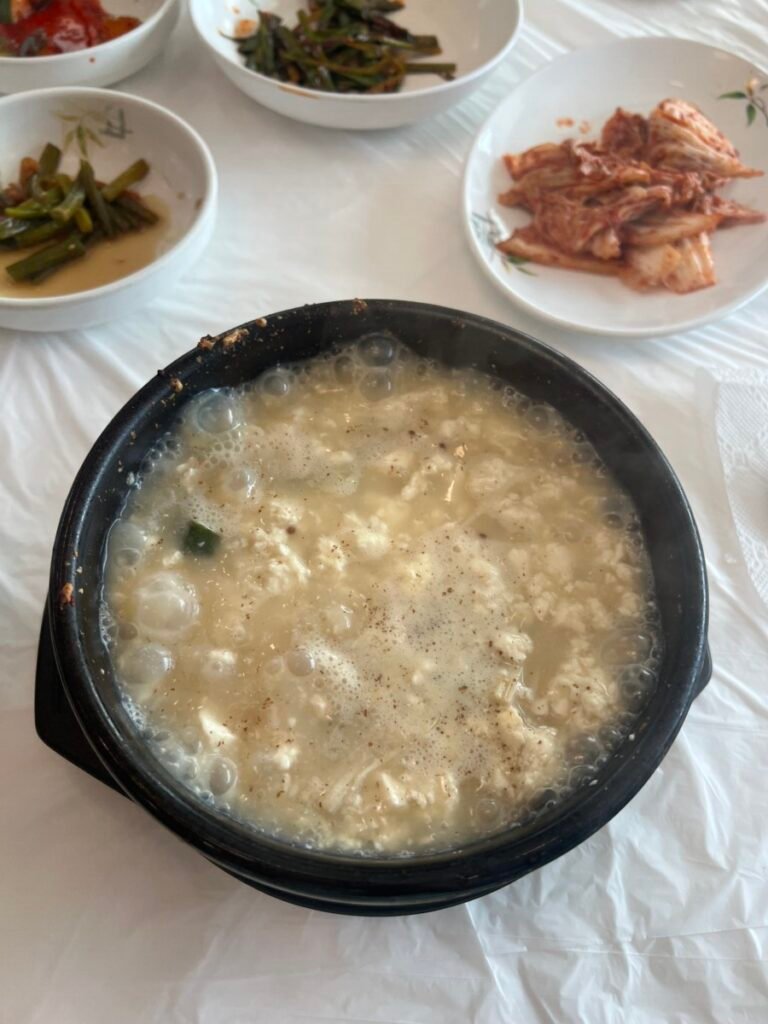
So after leaving Mireuksa, my wife and I went for sundubu-jjigae (순두부찌개).
Sundubu-jjigae is a Korean stew made with very soft tofu, usually served bubbling hot in a stone or earthenware-style bowl.
The contrast with the weather outside was slightly ridiculous.
We had just spent part of a hot summer day walking around an exposed archaeological site.
And then we sat down and ordered boiling stew.
But somehow it worked.
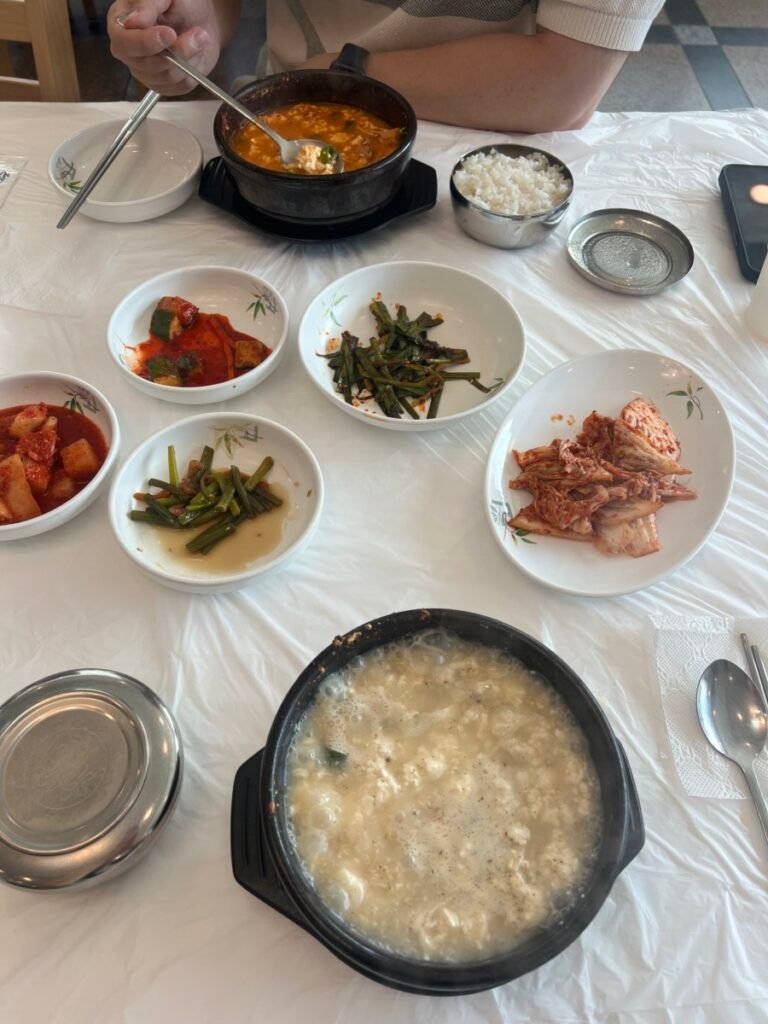
Our table quickly filled with the familiar Korean combination of rice, kimchi and small side dishes.
My wife ordered the red, spicier-looking stew, while mine arrived much lighter in color.
It wasn’t a fancy meal.
And I don’t think every travel memory needs to end at a famous restaurant.
After spending the morning walking through a place connected to seventh-century Baekje, sitting down in an ordinary local restaurant for a hot bowl of tofu stew felt like a very Korean way to end the trip.
History first.
Lunch second.
I was happy with that itinerary.
Is Mireuksa Temple Site Worth Visiting?
I think Mireuksa is especially worth visiting if you’re interested in Korean history beyond Seoul.
Seoul naturally dominates many first trips to Korea.
Gyeongbokgung, Bukchon and the surviving monuments of the Joseon Dynasty are much easier for international visitors to encounter.
But Korean history didn’t begin with Joseon.
Long before Seoul became the center of the country, kingdoms such as Baekje were building cities, temples and monuments while interacting with other societies across East Asia.
Mireuksa gives you a physical connection to that much earlier Korea.
And you don’t need to be an archaeologist to appreciate it.
Start with one simple question:
Why do the two pagodas look so different?
Once you understand the answer, the empty spaces around them begin to make more sense too.
You stop seeing two isolated stone towers.
You start imagining the enormous Buddhist temple that once stood between and around them.
That’s what I took away from our visit.
And that’s the kind of place I want to keep finding as I travel around Korea — somewhere that becomes more interesting once you know the story behind what you’re looking at.
After all, traveling deeper doesn’t always mean going farther.
Sometimes it just means knowing what you’re standing in front of.