
Some places are so famous that you feel like you already know what they look like before you ever visit.
The Grand Canyon was one of those places for me.
I had seen it countless times in photographs, movies, documentaries, and travel guides. Huge cliffs, red rock, endless layers stretching toward the horizon.
So when I finally visited while I was living in the United States, I thought I knew what to expect.
I didn’t.
Before reaching the canyon, however, there was another memorable stop along the way: Hoover Dam.
That made the trip feel like more than simply driving to one famous attraction.
In a single journey, I went from one of America’s most remarkable engineering projects to a landscape so enormous that photographs struggled to explain what I was actually seeing.
Our Las Vegas to Grand Canyon Road Trip
My Las Vegas to Grand Canyon road trip began early in the day, with the desert landscape gradually replacing the city behind us.
If you look at a map of the American Southwest, the Grand Canyon can appear deceptively close to Las Vegas.
It isn’t exactly next door.
Getting there takes a real drive, and depending on which part of the canyon you’re visiting, the route and travel time can be very different.
But that’s also part of what I remember about traveling in the United States.
Distances felt different from Korea.
A trip that might look significant on a Korean map could become just another drive in the American West.
And once you leave Las Vegas, the landscape begins to change quickly.
The hotels and casinos disappear.
The city becomes smaller behind you.
Then the desert takes over.
Before we reached the Grand Canyon, we stopped at one of the most famous structures in the region.
Stopping at Hoover Dam Along the Way
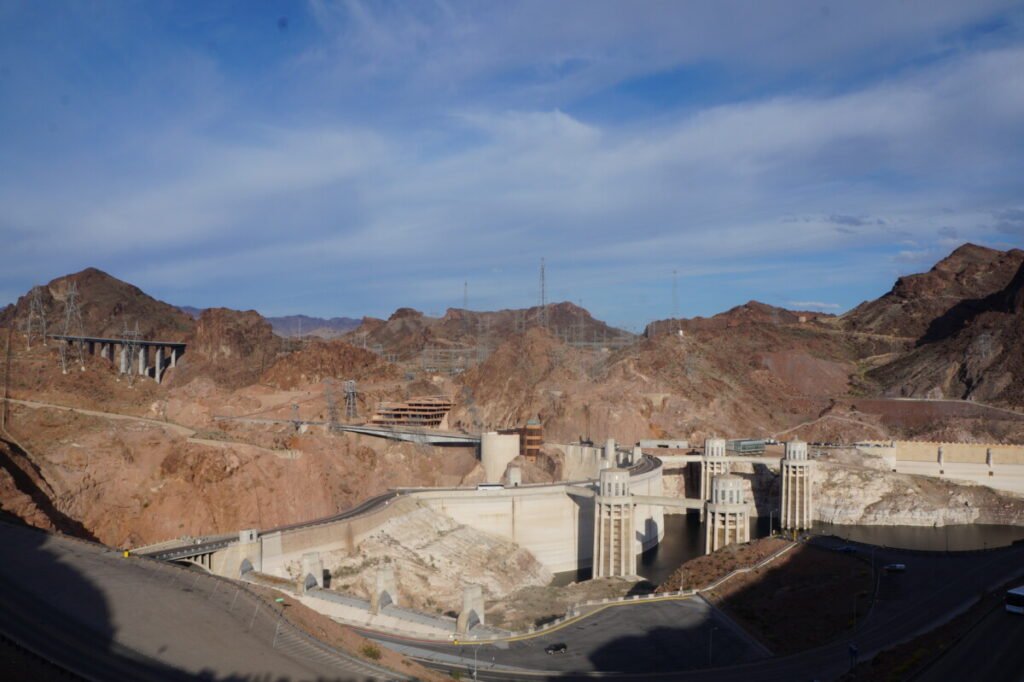
Looking down at Hoover Dam for the first time, what surprised me was how completely the structure seemed to occupy the landscape.
There was the enormous concrete dam below us.
Around it were steep, dry mountains.
Roads curved through the rock, bridges crossed the landscape, and electrical infrastructure spread across terrain that otherwise looked almost empty.
It didn’t look like something simply built on the landscape.
It looked embedded into it.
Hoover Dam was constructed in the 1930s on the Colorado River, on the Arizona-Nevada border. Today it remains both a working piece of infrastructure and a major visitor destination.
What I liked about stopping there on the way to the Grand Canyon was the contrast.
Hoover Dam is about human engineering on an enormous scale.
The Grand Canyon is almost the opposite.
There, the scale comes from nature and geological time.
Seeing the two on the same trip made both more memorable.
Then I Finally Saw the Grand Canyon
There are famous places that look smaller in real life than they do in photographs.
The Grand Canyon isn’t one of them.
If anything, photographs make it smaller.
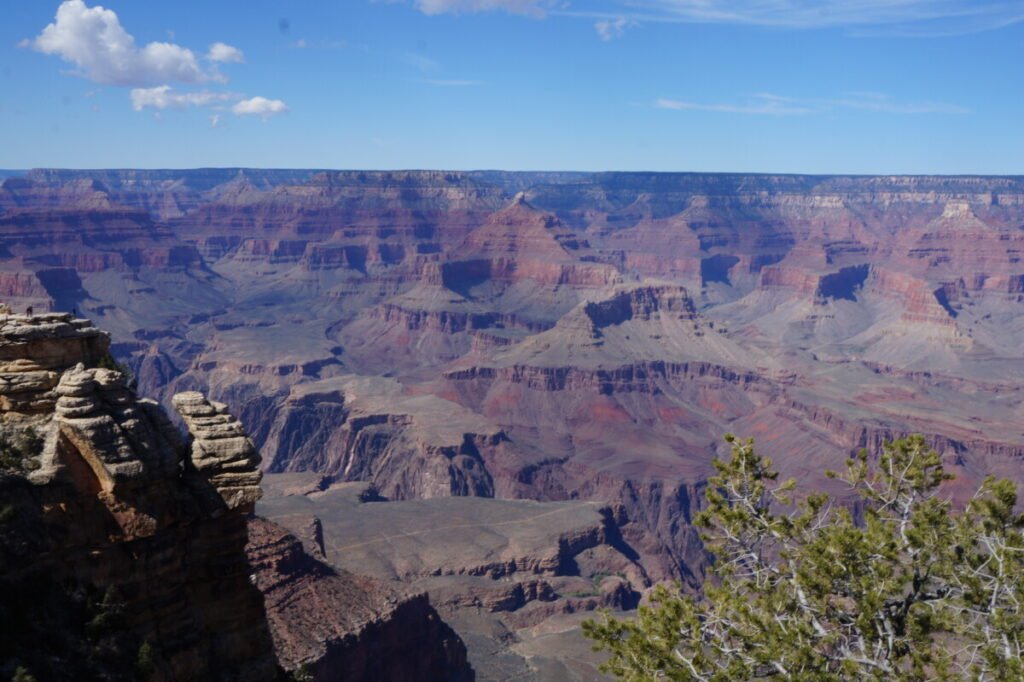
When I first stood at the rim and looked across the canyon, I had trouble understanding the scale.
There wasn’t one mountain or one valley to focus on.
There were layers.
Cliffs dropped into other cliffs. Plateaus appeared behind formations that were already enormous. Different shades of red, brown and gray continued farther into the distance until they almost blended into the horizon.
The National Park Service describes the Grand Canyon landscape as a combination of canyons, mesas, plateaus and geological formations, with major viewpoints along both the South and North Rims.
Standing there, those descriptions make more sense.
But even then, numbers and descriptions don’t quite capture it.
The Strange Problem With Photographing the Grand Canyon
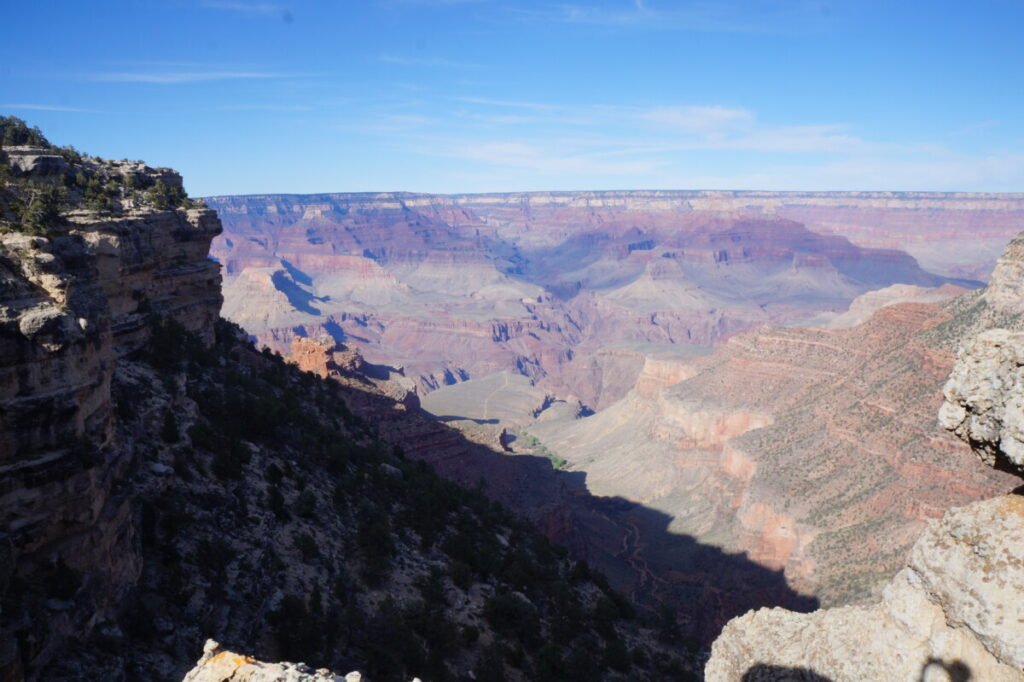
I took several photographs.
Looking at them now, they’re beautiful.
But they also remind me of something I noticed while I was there:
The Grand Canyon is surprisingly difficult to photograph.
Not because it isn’t photogenic.
It’s almost too big.
When you take a picture, everything is compressed into a flat frame. The cliffs in the foreground and the formations far in the distance suddenly seem much closer together.
Standing there is completely different.
Your eyes can move from the rocks immediately below you to formations many miles away.
The National Park Service even notes that from Mather Point, one of the South Rim’s best-known viewpoints, visibility on a clear day can extend more than 30 miles east and 60 miles west.
That gives some numerical sense of the scale.
But the feeling is harder to measure.
I remember looking at the view, then looking at the photograph on my camera, and feeling that the photograph had somehow lost something.
Maybe that’s why the Grand Canyon remains worth visiting even though everyone already knows what it looks like.
Seeing a photograph and understanding the scale with your own eyes are two different experiences.
What Surprised Me About the South Rim
Another thing I hadn’t fully appreciated before visiting was the elevation.
The South Rim averages around 7,000 feet, or 2,134 meters, above sea level.
That’s easy to forget when you’re simply looking at photographs of desert-colored rock.
You’re not standing at the bottom looking up.
You’re standing high above the canyon looking down into an enormous geological landscape.
And the experience doesn’t require hiking all the way into the canyon.
For a first visit, simply moving along the rim and stopping at different viewpoints can show how dramatically the landscape changes depending on your position and the light.
The National Park Service operates free shuttle routes around parts of the South Rim, and the Rim Trail also allows visitors to walk between many viewpoints.
If I were planning the trip again, I would give myself more time simply to walk along the rim rather than treating the Grand Canyon as one viewpoint where you take a photograph and leave.
Hoover Dam and the Grand Canyon Made an Interesting Pair
Looking back, I’m glad the trip included both places.
Hoover Dam and the Grand Canyon are completely different attractions, but putting them together created an interesting progression.
At Hoover Dam, I was looking at something humans had designed, calculated and constructed.
Then, at the Grand Canyon, I was looking at a landscape shaped over a timescale that is difficult to comprehend.
One is impressive because people built it.
The other is impressive because nobody did.
That contrast stayed with me.
It’s also why I think road trips can sometimes be more memorable than flying directly to a destination.
The places between your starting point and final destination become part of the story.
For me, Hoover Dam wasn’t simply another attraction I checked off a list.
It became the first chapter of my Grand Canyon trip.
Practical Tips I Would Keep in Mind
If you’re considering a similar trip, the most important thing is to know which part of the Grand Canyon you’re actually visiting.
“Grand Canyon” isn’t one single entrance with one viewpoint.
The South Rim contains Grand Canyon Village, Desert View Drive, numerous overlooks and trail access points. The National Park Service recommends using its park maps and shuttle information to plan how you move between them.
For a first visit, I would also keep a few simple things in mind: don’t underestimate driving distances in the Southwest, bring water, check weather and road conditions, and give yourself more time at the rim than you think you’ll need.
Most importantly, don’t feel that you need to identify every rock formation or complete a difficult hike for the visit to be worthwhile.
Sometimes standing there and looking is enough.
A Place I Thought I Already Knew
Before visiting, the Grand Canyon was almost too familiar to me.
I knew the image.
I knew the name.
I knew it was supposed to be enormous.
But visiting it reminded me why famous places can still be worth traveling to.
Sometimes the surprise isn’t discovering something you’ve never seen before.
It’s realizing that what you’ve seen hundreds of times in photographs is completely different when you’re finally standing in front of it.
My camera captured the cliffs, the colors and the blue Arizona sky.
What it didn’t really capture was the scale.
And maybe that’s the best reason I can give for visiting the Grand Canyon yourself.
Some landscapes still need to be seen in person.