There are many ways to celebrate New Year’s Day in Korea.
Some people stay up until midnight. Others watch the famous bell-ringing ceremony in central Seoul.
But another popular Korean New Year tradition begins much earlier — before the sun even rises.
Watching the first sunrise of the year.
On January 1, I decided to experience this Korean New Year tradition in a particularly peaceful setting: Sujongsa, a Buddhist temple in Namyangju, just outside Seoul.
The plan sounded simple.
Wake up early, climb to the temple, watch the first sunrise of the year, and start 2026 somewhere quiet.
What I hadn’t fully considered was that getting there would involve waking up in the middle of the night, walking uphill for more than an hour in the freezing cold, and joining a surprisingly large crowd with exactly the same idea.
But that turned out to be part of what made the experience memorable.
Why Do Koreans Watch the First Sunrise of the Year?
In Korea, January 1 isn’t only about counting down to midnight.
For many people, seeing the year’s first sunrise — called haemaji (해맞이) — is another symbolic way of welcoming the New Year.
People travel to mountains, beaches, observatories, and other places with open views of the horizon.
Some of Korea’s most famous sunrise destinations attract enormous crowds every January 1.
The idea itself is simple.
Watch the old year disappear, see the first sun rise, make a wish, and begin again.
You don’t have to be religious to participate. For many people, it is simply a meaningful ritual for starting the year.
And while beaches and mountain peaks are popular choices, I liked the idea of experiencing the first sunrise at a Korean Buddhist temple.
So we chose Sujongsa.
Sujongsa: A Buddhist Temple Above the Han River
Sujongsa is located on Ungilsan Mountain in Namyangju, Gyeonggi Province.
One reason people visit the temple is its location.
From high on the mountain, you can look across the surrounding landscape toward the meeting point of the North and South Han Rivers.
On an ordinary day, visitors can come here for the temple itself, the mountain scenery, and the view.
On New Year’s Day, however, there was another reason people were climbing the mountain before dawn.
Everyone was waiting for the same thing.
The first sunrise of the year.
Starting the Morning at 5:40 A.M.
We arrived at the first parking lot near Water Garden (Mul-ui Jeongwon) at around 5:40 a.m.
Normally, cars can get considerably closer to the temple.
January 1 was different.
Vehicle access toward Sujongsa had been restricted because of the number of people coming for the sunrise.
That meant we had roughly an hour of walking ahead of us.
Sunrise was expected at around 7:40 a.m., and it was brutally cold outside, so there was no reason to start immediately.
We stayed in the car until around 6:00.
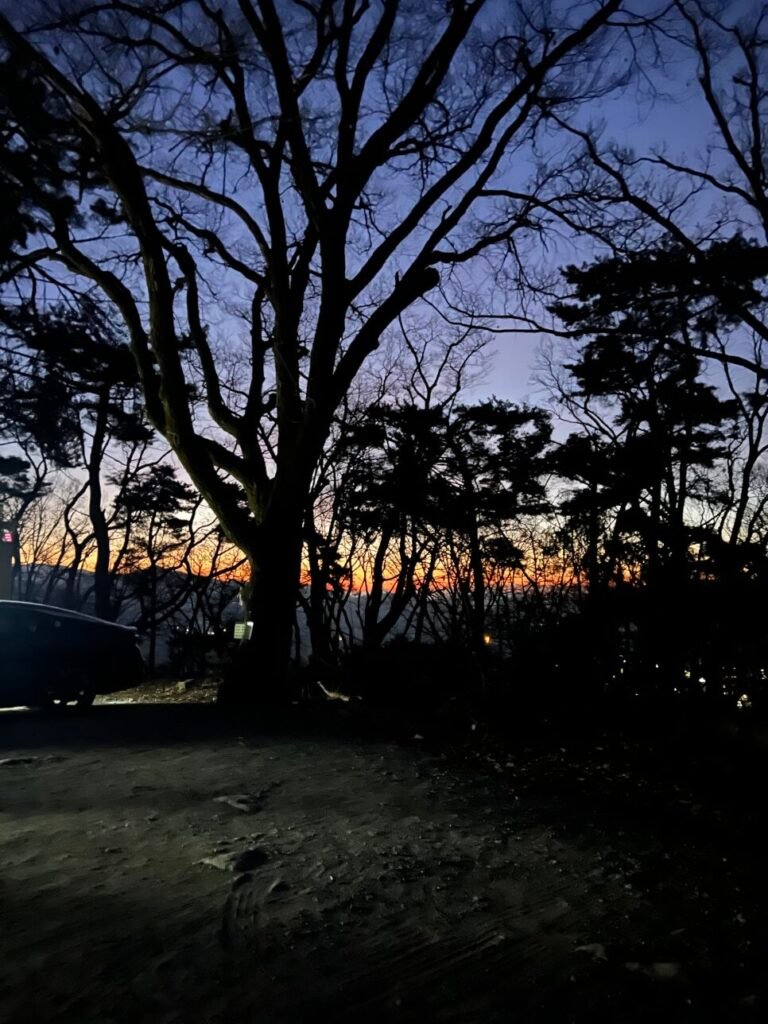
At that hour, everything outside was still completely dark.
Eventually, it was time.
We opened the doors, stepped into the cold and started walking.
The Climb Was Harder Than Expected
The route toward Sujongsa wasn’t quite what I had imagined.
Rather than feeling like a typical hiking trail through the mountains, much of the route followed a paved road used by vehicles.
That sounds easier.
Somehow, it didn’t feel easier.
The uphill road just kept going.
And going.
At first, we were talking.
After a while, there was noticeably less conversation.
The cold certainly didn’t help.
Still, there was something unusual about walking up a dark mountain road surrounded by other people all heading toward the same place before sunrise.
Everyone had woken up ridiculously early for one simple reason:
to see the first sun of the year.
We Weren’t the Only Ones With This Idea
We finally reached Sujongsa at around 7:10 a.m.
I had assumed that arriving 30 minutes before sunrise would be early enough.
I was wrong.
The temple was already crowded.
People had taken positions around the best viewpoints, particularly near the higher areas of the temple.
It was a reminder that haemaji isn’t some obscure Korean tradition.
A lot of people really do wake up before dawn on January 1 and travel somewhere specifically to watch the sunrise.
We walked around looking for somewhere less crowded.
And that’s when another Korean New Year tradition unexpectedly entered the story.
Tteokguk at a Buddhist Temple
The temple was serving visitors tteokguk (떡국).
If you’ve spent a New Year in Korea, you’ve probably encountered this dish.
Tteokguk is a soup made with sliced rice cakes, and it is traditionally eaten around the Korean New Year.
There is even a familiar Korean expression connecting a bowl of tteokguk with becoming one year older.
After walking uphill through the freezing darkness, receiving a warm bowl of soup at a Buddhist temple felt particularly good.
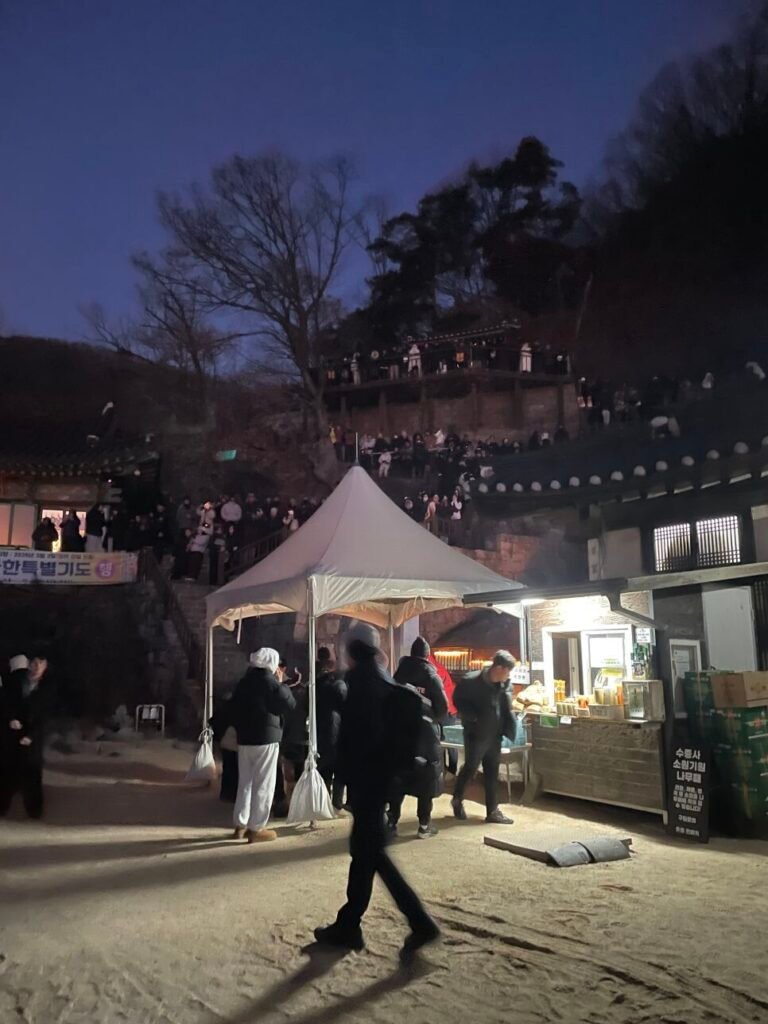
Standing there with a bowl of hot tteokguk while waiting for the year’s first sunrise felt almost like several Korean New Year traditions had accidentally come together in one morning.
A mountain.
A Buddhist temple.
The first sunrise.
And tteokguk.
For someone visiting Korea, these are the small experiences that can sometimes tell you more about a culture than checking another famous attraction off a list.
Watching the First Sunrise of 2026
Eventually, we found a quieter spot lower down.
It wasn’t the perfect panoramic viewpoint.
There were trees partially blocking the view, and we weren’t standing in the most famous photo spot at the temple.
But I actually preferred it.
There were fewer people around us.
We had our tteokguk.
And after the long, cold walk up the mountain, there wasn’t much else we needed.
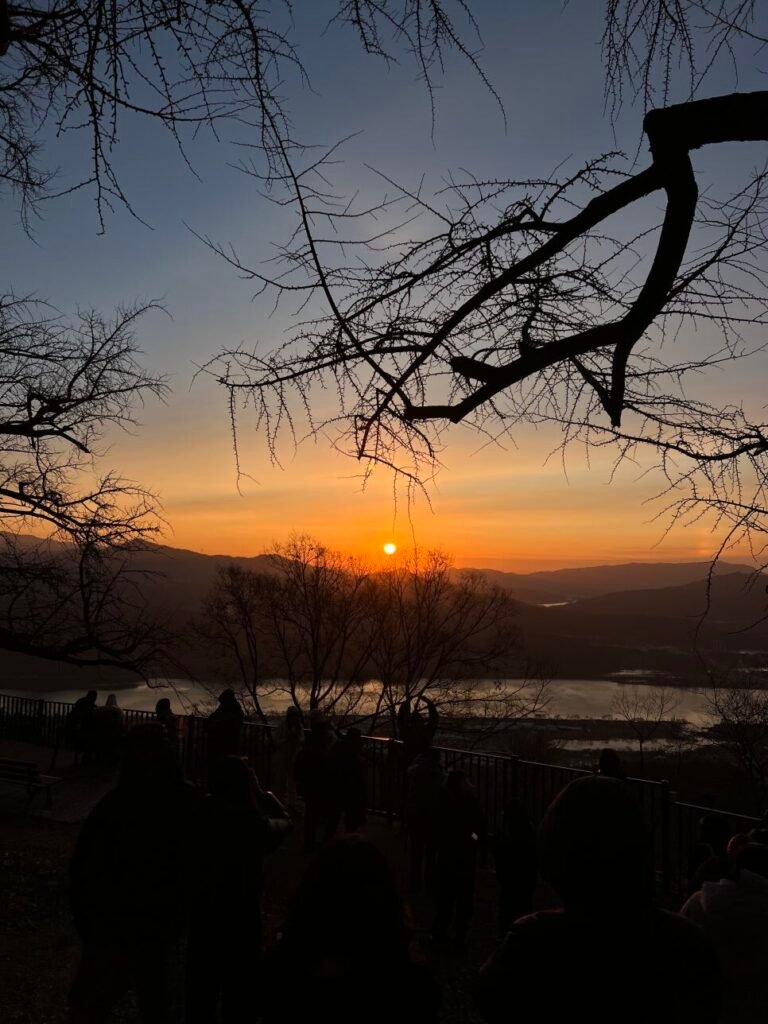
Then the sky began to change.
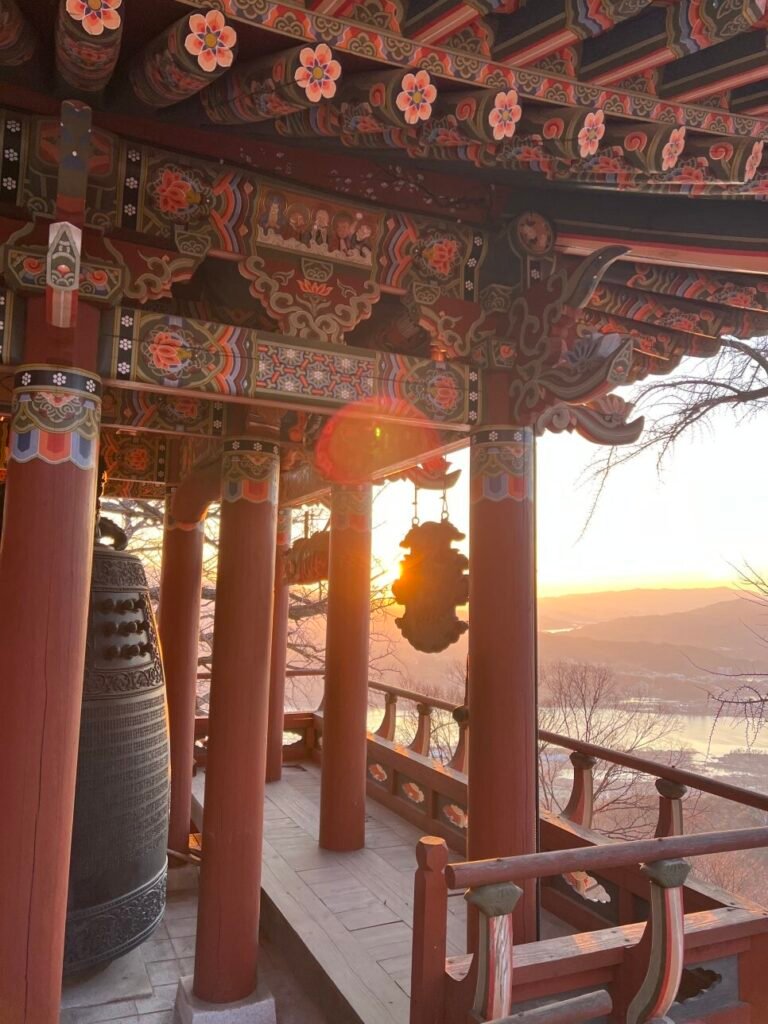
Slowly, the first sunlight of 2026 appeared over the landscape.
There wasn’t a dramatic countdown.
Nobody needed to announce that the New Year had begun.
We simply stood there and watched.
I remember thinking that this wasn’t a bad way to start another year.
More Than Just a Sunrise
Looking back months later, what I remember most isn’t whether we had the perfect sunrise view.
We didn’t.
I remember arriving in the darkness.
The freezing walk uphill.
Realizing hundreds of other people had arrived before us.
The unexpected bowl of hot tteokguk.
And finally watching the sky brighten from a Buddhist temple above Namyangju.
That’s what I like about traditions such as haemaji.
You don’t need to believe that seeing the first sunrise will somehow change the year ahead.
The experience simply gives you a moment to stop.
To think about the year that ended.
And to think about what you want from the one beginning.
For travelers, it can also be a different way to experience Korea.
Instead of only visiting a temple during normal sightseeing hours, you get to see a place become part of a living Korean tradition.
People aren’t there because a guidebook told them to visit.
They’re there because this is how they chose to begin their year.
And on that freezing January morning, so did we.